Padel Court Dimensions and Net Height Explained
Official padel court dimensions: the 20x10m size, net height, service lines, wall and glass specs to FIP standards - and how it compares to a tennis court.

A padel court is a precise, standardised space - and because the walls are part of the game, those measurements matter more than on an open court. Whether you are learning the layout, settling a debate, or planning to build one, here are the official International Padel Federation dimensions and what each part of the court is for.
Official padel court dimensions (FIP)
- Court length
- 20 m (0.5% tolerance)
- Court width
- 10 m (0.5% tolerance)
- Net length
- 10 m
- Net height (centre)
- 88 cm
- Net height (side posts)
- up to 92 cm
- Service line
- 6.95 m from the net
- Back walls
- 4 m high (3 m glass + 1 m mesh)
- Side walls
- 4 m for first 2 m, then 3 m
- Glass thickness
- 10-12 mm tempered
- Mesh aperture
- 5 - 7.08 cm
- Line width
- 5 cm
- Recommended ceiling
- 8 m clear height
How big is a padel court?
The official padel court is 20 metres long by 10 metres wide, with a permitted tolerance of 0.5% either way. That rectangle is split in half by the net, giving each side a 10m by 10m playing area enclosed by walls. The whole space is roughly a quarter the footprint of a tennis court, which is part of why padel works so well as a fast, reactive doubles game - there is less ground to cover and the walls keep the ball alive.
What is the net height?
The net runs the full 10m width of the court. It is 88cm high at the centre and rises slightly to a maximum of 92cm at the side posts - the same gentle dip-in-the-middle profile as a tennis net. That lower centre is why down-the-middle shots are a staple of padel tactics: the net is at its most beatable there.
Where are the service lines and boxes?
On each half of the court, a service line is marked 6.95m back from the net, running parallel to it. A centre service line then splits the area between the net and the service line into two service boxes, left and right. The server must land the serve in the diagonally opposite box, having bounced the ball and hit it underarm at or below waist height. The 3.05m of court behind each service line, up to the back wall, is where most defensive play and wall returns happen. For the full serve and play rules, see our padel rules guide.
What are the walls and glass made of?
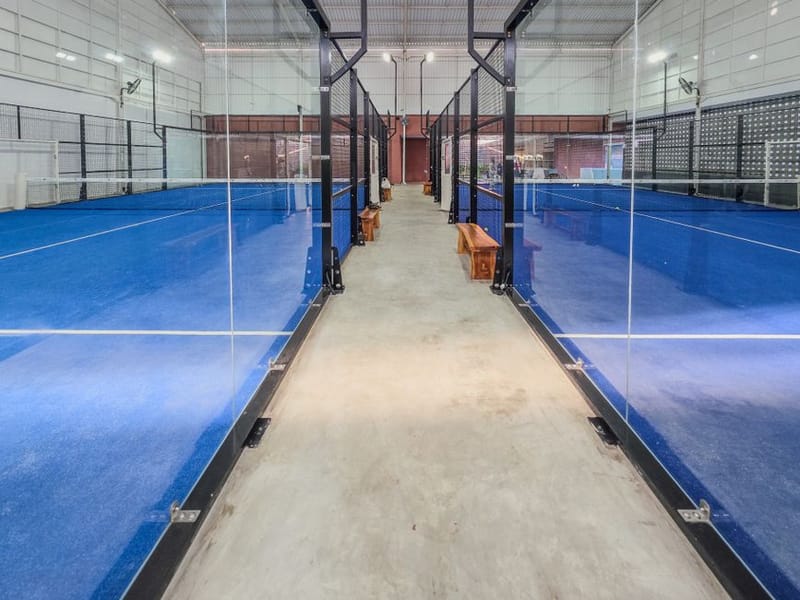
The enclosure is what makes padel unique, and it is specified carefully. The back walls are 4m high - the bottom 3m is tempered glass (10-12mm thick, strong enough to take repeated high-speed ball impacts) and the top 1m is metallic mesh. The side walls are also 4m high for the first 2m from the back, then step down to 3m for the rest of their length. The mesh aperture is kept between 5cm and 7.08cm, and all court lines are 5cm wide. For new builds, a clear ceiling height of 8m over the whole court is recommended. The mix of glass and mesh affects how the ball rebounds - see our guide to padel court types for how panoramic, corner and multisport variants differ.
How does a padel court compare to a tennis court?
A padel court (20m x 10m) is dramatically smaller than a tennis court (which is about 23.77m long and 10.97m wide for doubles, with run-off beyond that). The headline differences: padel is enclosed by walls that are in play, the net is lower and shorter, the serve is underarm, and the smaller area means a doubles pair can cover the court far more easily. It is closer in spirit to a squash-meets-tennis hybrid than to tennis itself. If you are weighing the sports up, our padel vs tennis comparison goes into the differences in play.
Frequently asked questions
What are the dimensions of a padel court?
How high is a padel net?
How far is the service line from the net in padel?
How high are the walls on a padel court?
Is a padel court smaller than a tennis court?

Padel Rules: The Complete Guide
Padel Court Types
Padel Court Surfaces Compared