Padel Doubles Communication and Partner Play
Padel doubles communication wins more points than power. Learn shot-calling, who takes the middle, and how to play as one unit instead of two.
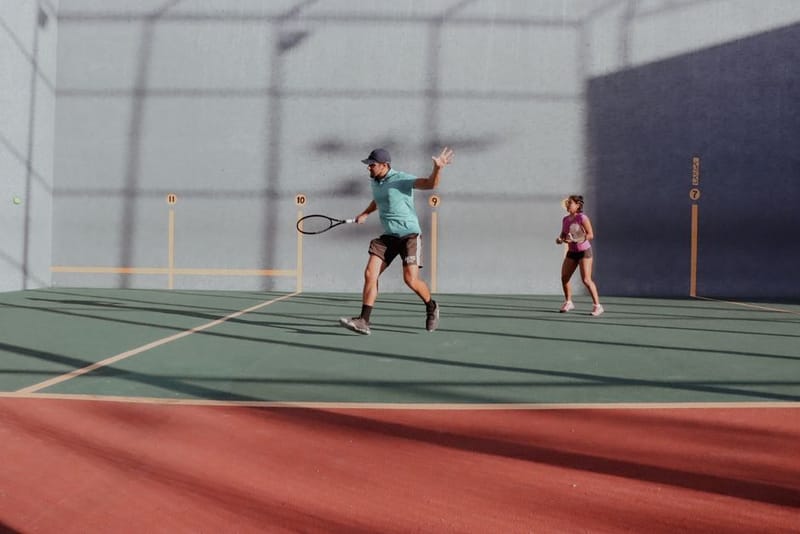
Padel doubles communication is the cheapest upgrade in the game. You do not need a better racket or a bigger smash to win more points with the partner you already have. You need to call the ball, share a plan, and move as a connected pair instead of two players occupying the same court. The teams that talk constantly look slower and calmer, and they win the points that silent pairs hand over through hesitation.
Why does communication matter so much in padel?
Padel is played almost entirely as doubles on a small, enclosed court, so you and your partner constantly share overlapping space. The ball down the middle, the lob over your heads, the switch when one of you is pulled wide: every one of these is a decision two people have to make in the same instant. Without a call, you both react to the other's body language a fraction too late. A short, loud word removes that hesitation and turns two individual reactions into one team decision.
Who takes the ball down the middle?
The middle ball is where most doubles points are won and lost. Three simple conventions sort it out. First, whoever has the forehand in the middle usually takes it, because it is the stronger, more controllable shot. In a right-hander and right-hander pair that is the player on the left; in a left-hander and right-hander pair both forehands point to the middle, which is why that pairing is so strong. Second, the player moving forward takes priority over the player moving back. Third, and above all, whoever is going to play it says so early: a sharp "mine" or "me" before the ball arrives, not as you both swing.
The matching call matters just as much. If it is not yours, say "yours" or "leave" so your partner commits without doubt. Silence is the enemy.
What should you actually say on court?
Keep the vocabulary tiny so it works under pressure. A handful of one-word calls covers almost everything:
"Mine" / "Me"
I am taking this ball. Said early, before the swing.
"Yours"
You take it. Commits your partner without hesitation.
"Leave" / "Bounce"
Let it go: it is heading out, or it will come off the back glass for an easier ball.
"Switch"
We are swapping sides after a lob pulled one of us across.
"Up" / "Back"
A reminder to take the net together or retreat together, never split.
"Last" / "Out"
The ball is drifting long: leave it for the glass or the line.
How do you plan a point before it starts?
The best pairs exchange a quick word before serving or returning. It can be as simple as agreeing where the serve goes and who covers the likely reply, or a hand signal behind the back at the net to say "I am poaching the next one down the line". Pre-point planning removes surprise between partners and lets you set traps together rather than reacting separately. You do not need a complex system: one shared intention per point is enough to keep you connected. For where to stand while you execute it, our court positioning fundamentals guide covers the basics.
How do you support a partner who is struggling?
This is where good pairs separate from frustrated ones. When your partner misses, the worst response is silence or a sigh; the best is a short, genuine reset: "next one", "good idea", "we go again". Padel swings on momentum, and a partner who feels blamed tightens up and misses more. Keep your own body language open between points, take a little more of the court if they are out of rhythm, and save the technical chat for after the match. You win as a pair or not at all, so the emotional side of communication is not soft: it is tactical.
Common communication mistakes to avoid
Three patterns cost recreational pairs the most points. Calling too late, so the word and the swing arrive together and you both still hesitate. Going quiet under pressure, exactly when calls matter most. And over-coaching a partner mid-point, which adds noise instead of clarity. Fix the first by calling as the ball leaves the opponent's racket, the second by making calling a habit on easy balls so it survives the hard ones, and the third by saving feedback for the changeover. If you are still building these habits alone, our solo drills guide includes shadow routines that ingrain the calls.
Padel Doubles Tactics: Partner Positioning UK 2026
Padel Court Positioning Fundamentals UK 2026

How to Find a Padel Partner in the UK (2026)